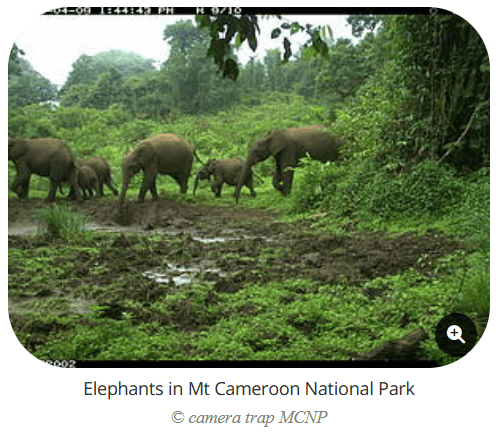
This week, the shout-out goes to our PhD student Krystof Korejs, whose first-authored paper has just been published in the Journal of Animal Ecology! 🎉
Based on fieldwork on Mount Cameroon in Africa, Krystof and his co-authors explored how African forest elephants shape tropical forest bird communities (still during his Master degree). Their findings reveal an ecological paradox: elephants reduce bird species richness but increase functional diversity.
By comparing elephant-grazed primary rainforest, ungrazed primary forest, and human-disturbed secondary forest, the team found that bird species richness in elephant-grazed forests was comparable to that in heavily disturbed secondary forests. Yet the composition of these communities told a very different story. Elephant-grazed forests supported more understory- and ground-dwelling insectivores, whereas ungrazed forests provided habitat for fruit-eating birds and larger species. Human-disturbed forests, in contrast, hosted a distinct community dominated by birds associated with more open habitats.
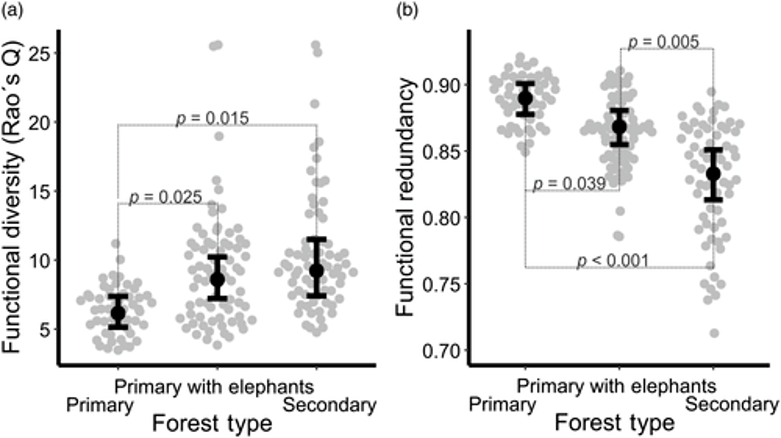
This study highlights the complex role of large herbivores in shaping tropical forest ecosystems and shows why understanding which species are present, and what ecological roles they perform, is just as important as counting how many there are.
Congratulations, Krystof! 🐘🌳🐦
Full text is available here: https://besjournals.onlinelibrary.wiley.com/doi/10.1111/1365-2656.70369