Tropical islands host unique evolutionary lineages, yet these endemic species are often highly vulnerable to environmental change. Understanding how they contribute to ecosystem functioning is essential for effective conservation. This is because, the protection of endemic species is justified not only in their vulnerability to external threats, but in their frequently irreplaceable role in the ecosystems they inhabit. Our research therefore explored this question on New Britain, the largest island of the Bismarck Archipelago, by examining how bird communities change along an elevational gradient and how endemic species support key ecological processes.

Figure 1. New Britain and its mountain ranges
Using field surveys combined with abundance‑weighted trait data, we compared the functional roles of New Britain’s birds with those on the neighbouring mainland of New Guinea. Bird diversity declined non‑linearly with elevation, yet the share of endemic species increased from 42% in the lowlands to 55% in montane forests. Across elevations, New Britain bird assemblages relied less on invertebrate prey and more on nectar and fruit than their New Guinean counterparts – a shift most pronounced at higher elevations and driven by both endemic and non‑endemic species.
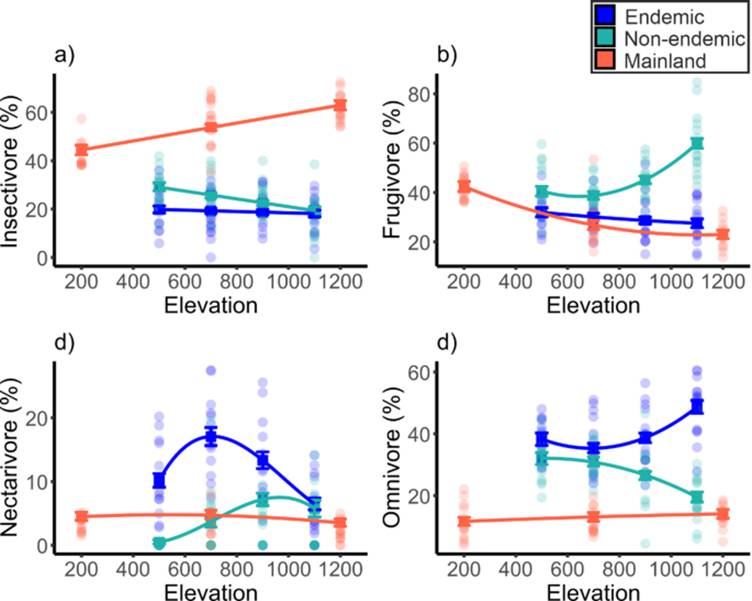
Figure 2. Elevational patterns of trophic composition, as predicted by our models. The legend describes the different trends corresponding to either New Britain birds (endemic and non-endemic), and mainland birds of New Guinea. The squares denote mean values predicted by each respective model, while brackets show the standard error of the predicted mean. The fit line corresponds to the degree of polynomial terms used to model the effect of elevation in each respective model. Semi-transparent points plot the base trait values used to model elevational patterns. Plotted are results for the proportion of bird abundances represented by (a) insectivores, (b) frugivores, (c) nectarivores and (d) omnivores, for each of the three species groups.
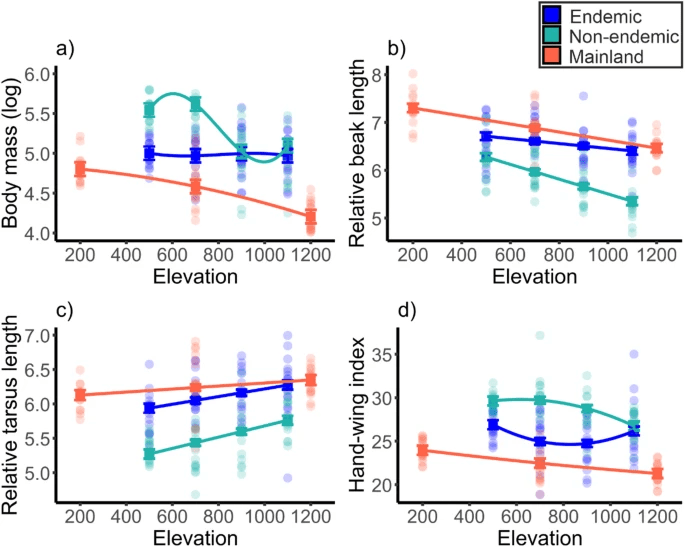
Figure 3. Elevational patterns of community weighted means of morphological traits, as predicted by our models. The legend describes the different trends corresponding to New Britain birds (endemic and non-endemic), and mainland birds of New Guinea. Squares denote mean values predicted by each respective model, while brackets show the standard error of the predicted mean. Fit lines correspond to the degree of polynomial terms used to model the effect of elevation in each respective model. Semi-transparent points plot the base trait values used to model elevational patterns. Plotted are results for community weighted means of (a) body mass, (b) beak length, (c) tarsus length, and (d) hand-wing index.
Endemic birds were especially important for pollination, although many adopted flexible foraging strategies in response to seasonal resource availability. In contrast, seed dispersal and insect control were dominated by non‑endemic species. These patterns suggest that New Britain’s avifauna possesses a distinct functional signature that may shape its response to land‑use change differently from mainland systems.
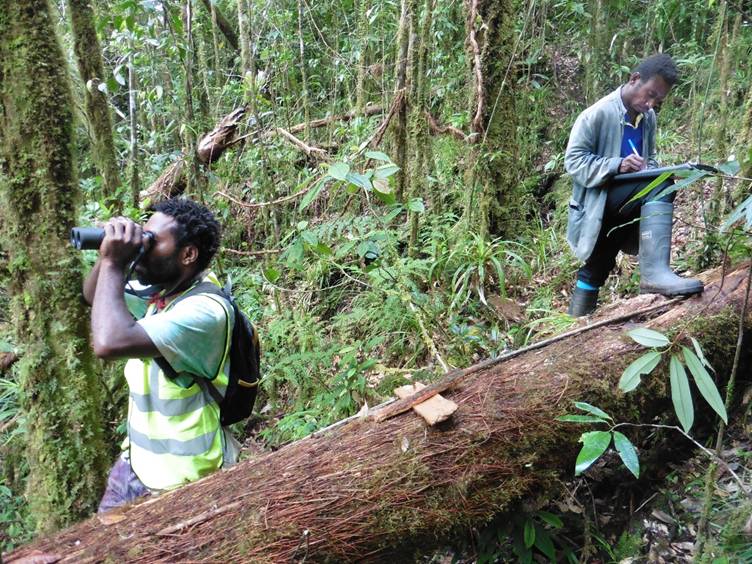
Figure 4. Field sites and Bonny Koane during the survey
Because only some ecosystem services depend primarily on endemic species, conserving the full spectrum of avian diversity—rather than focusing solely on endemics—will be crucial for maintaining resilient rainforest ecosystems on New Britain.

¨Figure 5. Variable goshawk captured to mist-nets during the survey
You can find the full story in our paper in Biodiversity and Conservation
Korejs, K., Hazell, R., Koane, B., Novotný, V., Toko, P., Sosanika, G., & Sam, K. (2026). Endemic species maintain avian diversity and ecosystem services on the island of New Britain. Biodiversity and Conservation, 35(2), 46.
 multitrophicinteractions.blog