In our new paper, led by Jan Kollross, we tackle a central question in ecology: how nutrient enrichment (a bottom-up force) and predator exclusion (a top-down force) influence arthropods, herbivory and trophic interactions. With rising anthropogenic nutrient inputs (e.g., nitrogen deposition) and concurrent changes in predator communities, understanding how these forces interact is timely and relevant. Therefore, we challenged and refined the classic trophic-framework expectations (that increased resources → increased herbivores; that predator removal → increased herbivores) by showing more nuanced responses. Specifically, we found that the bottom-up (nutrient addition) rather than top-down forces (removal of predators) affect the resulting herbivory damage of trees.
We investigated how predator exclusion and fertilisation affect arthropod densities, sizes and herbivory on two temperate forest tree species. Using a factorial design, we compared fertilised and unfertilised trees with and without the exclusion of flying vertebrate predators in the forest understory during September 2020 and 2021. We collected and identified arthropods into feeding guilds. Fertilisation, but not predator exclusion, increased herbivory damage on trees as well as the size of predatory arthropods on the fertilised trees. Nutrient addition and predator exclusion had no significant effect on arthropod density. These patterns may indicate that the additional nutrients could have attracted herbivores, which in turn attracted their predators and may have enhanced their activity, thus potentially offsetting detectable changes in herbivore density. These results suggest that nutrient enrichment and predator exclusion interact, with nutrient addition affecting plant growth and herbivory damage primarily, but also increasing the size of predatory arthropods, but not the size of all arthropods. Effects of predator exclusion were less pronounced, potentially due to larger predatory arthropods compensating for the absence of flying vertebrate predators. Our study provides fully factorial field tests of top-down and bottom-up forces in a temperate forest understory, underscoring the critical need to evaluate how diverse ecological interactions mediate the synergistic effects of nutrient pollution and the ongoing decline of insectivorous vertebrate predators on arthropod communities and herbivory damage, particularly as these pressures intensify in our rapidly changing environment.
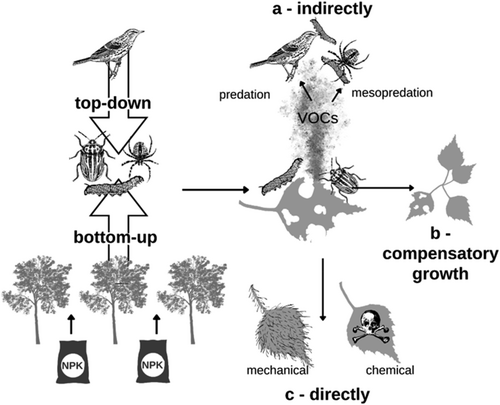
Conceptual diagram of top-down and bottom-up effects on arthropod community, herbivory and plant responses. Fertilisation (bottom-up forces) increases plant growth and resource availability for herbivores, while predators (top-down control) reduce arthropod herbivores through direct predation and intraguild mesopredation. Plants can defend themselves against herbivory in three main ways: (a) directly, (b) by compensatory growth or (c) indirectly. Direct defences include mechanical barriers (e.g. spines, trichomes) and chemical compounds. Indirect defences are mediated via volatile organic compounds (VOCs) emitted by damaged plants, which can attract predators or parasitoids of herbivores.

Our two-year nutrient enrichment and predator-exclusion experiment produced little change in overall arthropod density, despite increases in arthropod body size on fertilized trees and a higher presence of larger predators. These results suggest that nutrient inputs and predator removal primarily influence behaviour and body size rather than abundance, aligning with recent work on non-consumptive effects and behavioural trophic cascades. They also show that plant species and their defensive traits can override classic top-down and bottom-up expectations, highlighting the need for longer-term studies that also incorporate mutualists and soil processes.
https://resjournals.onlinelibrary.wiley.com/doi/10.1111/een.70038
 multitrophicinteractions.blog