🌿 Did you think that tropical rainforests were just lush green walls full of bugs doing bug things all year round?
Well, we spent a full year by hanging in the canopy crane gondola in Papua New Guinea to tell you: Nope. It’s complicated. (feel free to ask katerina.sam.cz(at)gmail.com for full pdf version)
🕵️♀️ We tracked insect herbivory damage in time and arthropod dynamics from 1 m to 30 m above ground (stopping every 5 m), across wet and dry seasons, on 9,425 leaves, and counted 3,445 arthropods.
That’s right—someone had to stare at all those leaves. And not only once. Three times.🌿 Ever tried marking a leaf in the canopy of a tropical rainforest, leaving it there, and then finding that exact leaf months later? You’re welcome.
📊 What we found:
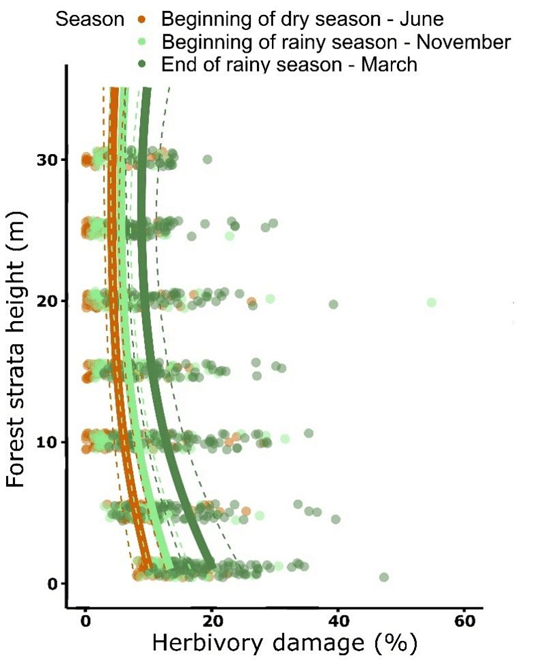
– Insects eat more when it’s wet. Shocking.
– Herbivores make the trees suffer more in the understory than in canopy.
– Leaf traits change with height. Plants – are not passive salad bars.
– The forest is vertically and seasonally dynamic—basically a rainforest version of rush hour.
🎯 Bottom line: Insect-plant interactions are shaped by microclimate, leaf toughness, and forest architecture, all changing with the seasons.
🙏 Thanks to the amazing folks at Kau WMA and the Binatang Research Center for making this wild ride possible.
Funded by ERC (BABE 805189), who apparently thought hanging on the cranes was a good idea – and so did we.

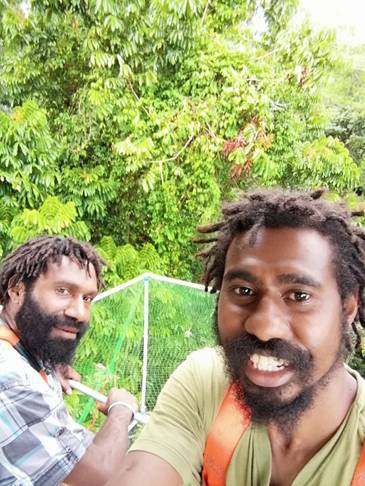
Bonny Koane and Heveakore Maraia working in the forest canopy
Abstract
How abiotic and biotic factors regulate insect-plant interactions in tropical forests is of great interest in ecology. However, our understanding of these factors across vertical stratification in tropical rainforests remains limited. We examined the effects of seasonality, microclimate, and leaf traits on insect herbivory and arthropod dynamics across vertical forest stratification in a weakly seasonal tropical rainforest in Papua New Guinea. We surveyed insect herbivory and arthropods on seven dominant tree species at 5m increments from 1m to 30m, three times during both dry and wet seasons. We assessed herbivory damage on 9,425 leaves and collected 3,445 arthropods from 407.07m2 of foliage. Herbivory damage decreased non-linearly with forest height and was highest during the wet season. Herbivorous arthropod density mirrored this pattern, peaking at the onset of the rainy season and remaining low at the start of the dry season and the end of the wet season. Predatory arthropod densities peaked in the canopy at the beginning of the wet season. Temperature, leaf dry matter content, and leaf toughness increased with forest height, while specific leaf area decreased. We conclude that forest stratification and seasonality play vital roles in mediating the rate of insect herbivory and arthropod community dynamics in the tropical lowland rainforest of Papua New Guinea.
Key words: Arthropods, chewing herbivores, insect herbivory, Kakoba Research Crane, New Guinea’s tropical rainforest, vertical forest gradients
Acknowledgement
We are thankful to the New Guinea Binatang Research Center for providing logistics and accommodation for this research work at its biological field research station. We extend our gratitude to the local field assistants of the Kau Wildlife Management Area for their assistance to H.M. during the experiment.
Financial support
This work was supported by the European Research Council – Starting Grant (BABE 805189) to K.S.
 multitrophicinteractions.blog