How feeding specialisation shapes bird communities across a tropical elevational gradient
Montane rainforests serve as natural laboratories where biodiversity shifts dramatically with elevation. But what drives these changes in bird communities? A recent study by Korejs et al. (2025) explores how feeding specialisation shapes avian functional diversity along an uninterrupted rainforest gradient in Papua New Guinea, spanning from the lowlands at 200 m above sea level to the treeline at 3700 m.
A Unique Setting for Bird Ecology
This study is one of the first to examine functional diversity across a fully intact tropical rainforest elevational gradient. The researchers conducted extensive point-count surveys at eight sites along Mt. Wilhelm, documenting over 25,500 birds from 232 species. They focused on three key aspects of functional diversity—functional richness, evenness, and divergence—while also assessing phylogenetic diversity and shifts in individual traits, including beak size, body mass, and dispersal ability.
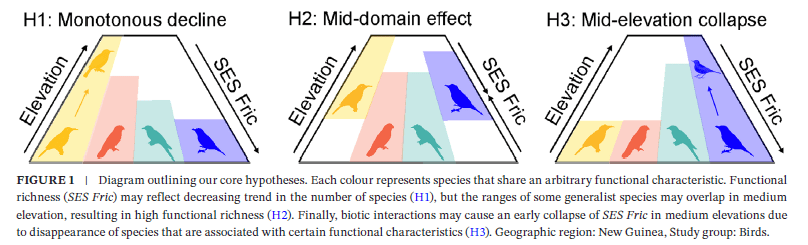
Key Findings: The Mid-Elevation Collapse
A striking pattern emerged: functional richness declined steeply from the lowlands to mid-elevation (1700 m), then plateaued toward the treeline. This ‘mid-elevation collapse’ coincided with shifts in trophic interactions. Large-fruited trees became scarce at mid-elevation, leading to declines in frugivore body size and beak dimensions. Meanwhile, insectivores thrived in these mid-elevation forests, where invertebrate abundance was highest, resulting in functionally similar bird communities.
Functional evenness—a measure of how evenly species are distributed in functional space—decreased monotonically with elevation. This suggested that as elevation increased, certain ecological roles became dominant, squeezing out functional variety. Conversely, functional divergence (which indicates how functionally distinct the most abundant species are) showed a complex pattern: increasing in the lowlands, dipping at mid-elevations, and rising again near the treeline.
The Role of Environmental Filtering
At high elevations, where harsh climatic conditions and sparse vegetation prevail, environmental filtering became the dominant force shaping bird communities. Morphologically, birds shifted toward terrestrial lifestyles with reduced dispersal ability, reflected in shorter wings and longer legs. Phylogenetic diversity also declined with elevation, indicating that closely related species with similar adaptations were more likely to persist in extreme conditions.
Conclusion
By integrating detailed trait analyses with functional and phylogenetic diversity metrics, this study provides a fresh perspective on how birds adapt to changing environmental conditions along tropical mountains.


Link to the original paper: https://onlinelibrary.wiley.com/doi/10.1111/jbi.15103?af=R
Full version PDF available upon request
First author: Kryštof Korejs – Ph.D student at University of South Bohemia

 multitrophicinteractions.blog