It was my pleasure to be part of the global experiment, in which the predation on live and artificial prey was studied. Together with many other authors, led by Elena Zvereva, we exposed plasticine and real puparia of flies and observed the attack rates on them. We also exposed live maggots in small vials, from where ants were able to carry them away. All this was done on the trees with were freely accessible to ants and on the trees to which the access of ants was prevented by a sticky tangle glues.

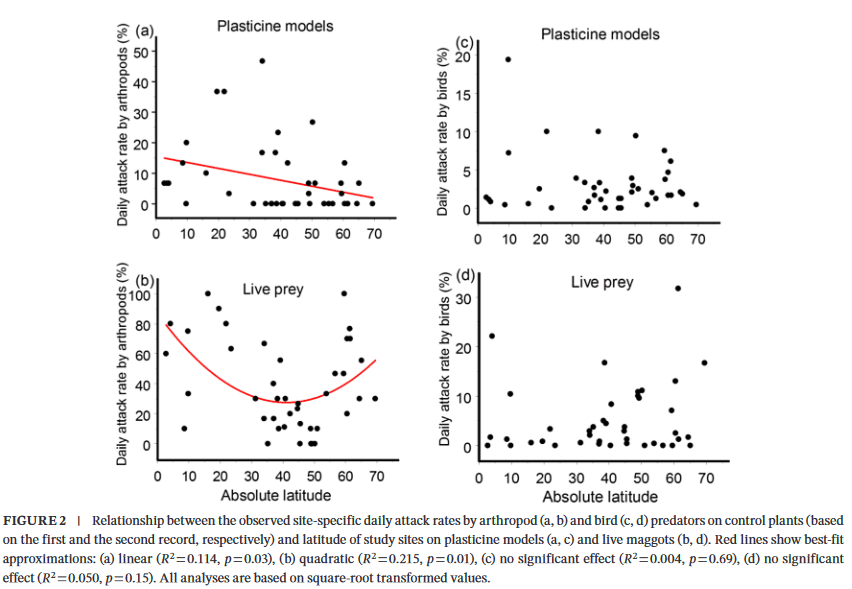
We found that the arthropod attack rates on plasticine puparia decreased linearly from low to high latitudes, whereas attack rates on maggots had a U shaped distribution, with the lowest predation rates at temperate latitudes and the highest rates at tropical and boreal latitudes. This difference emerged from intensive predator attacks on live maggots, but not on plasticine models, in boreal sites. This study also concludes that latitudinal patterns in predation differ between major groups of predators and between types of prey (but to me, I am still rather critical to how reliable the comparisons between the taxa are). We further say, that poleward decreases in both arthropod and combined arthropod and bird predation on plasticine models did not mirror patterns of predation on our live prey, the latter likely reflecting real patterns of predation risk better than do patterns of attack on artificial prey. The sticky barrier preventing the access of ants to the trees resulted into a decrease of the number of attacks in all habitats, mostly significantly.
The whole manuscript in its full-text is available here: https://onlinelibrary.wiley.com/doi/pdf/10.1111/geb.13899
 multitrophicinteractions.blog