Today, the day when we were saying final bye to our two students, Elise Sivault and Sam Finnie, our methodological paper from Tomakomai has been published online. The “Tomakomai” paper, was first-authored by Elise Sivault and Jan Kollross, who were responsible for the publication equally.

The paper not only comments on the importance of the various predators in Japanese forests, but it also represents a full and first methodological piece from our ERC grant. BY excluding the predators individually and in combinations, we showed that: Arthropods responded similarly to predator exclusion across forest strata, with a density increase of 81% on trees without vertebrates and 53% without both vertebrates and ants. Additionally, bird exclusion alone led to an 89% increase in arthropod density, while bat exclusion resulted in a 63% increase. Herbivory increased by 42% when vertebrates were excluded and by 35% when both vertebrates and ants were excluded. Bird exclusion alone increased herbivory damage by 28%, while the exclusion of bats showed a detectable but non-significant increase (by 22%). In contrast, ant exclusion had no significant effect on arthropod density or herbivory damage across strata.
Full paper is so far behind pay wall: http://doi.org/10.1111/1365-2656.14146
However, preprint is freely available: https://www.biorxiv.org/content/10.1101/2023.11.07.565745v1

Effects of the birds and bats, as well as vertebrates and ants differed.
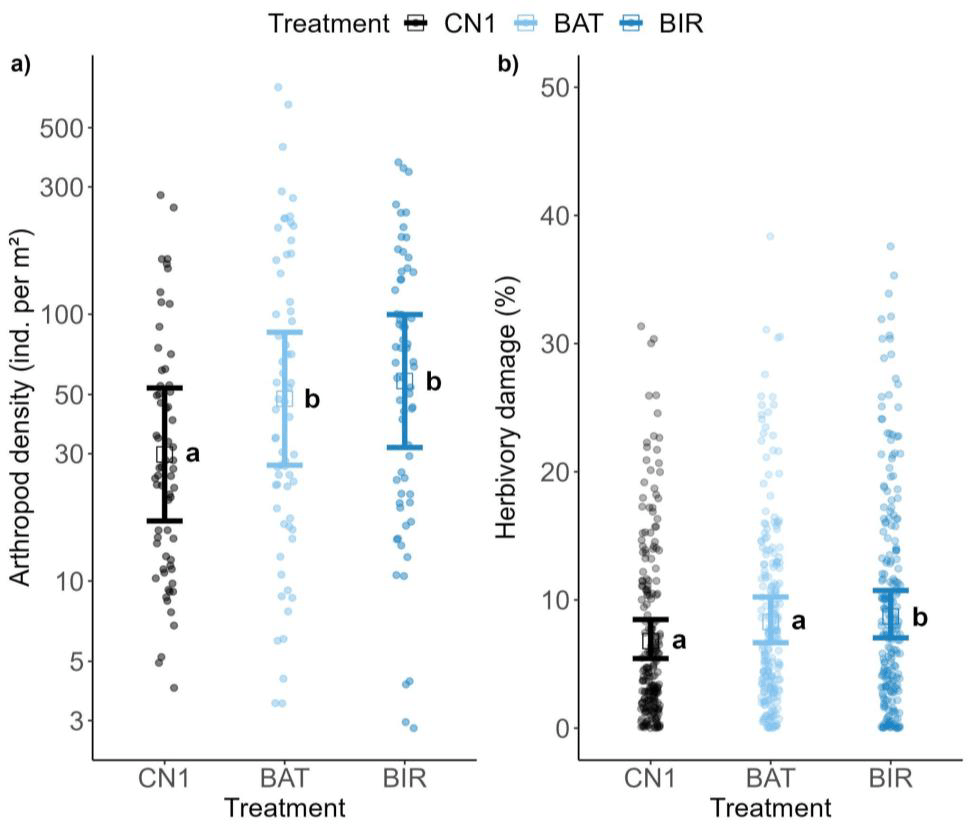
Effects of the exclusion of birds and bats on the total densities of all arthropods per square metre of foliage (a) and on the herbivory damage of individual saplings of the UBB (Understory Bird and Bat exclusion) experiment.

Total densities of all arthropods per square metre of foliage (a) and herbivory damage (%) (b) on surveyed saplings and branches of the CUVA (Canopy and Understory Vertebrate and Ant exclosure) experiment. CN2 = control treatment, ANT = ant exclosure, VER = vertebrate exclosure, ALL = all predator exclosure.
 multitrophicinteractions.blog