Tomakomai in Japan was the very first site we started to survey as a part of the BABE European research grant. Four years later, with nearly whole ERC team on board, we put together a preprint which we submitted to Journal of Animal Ecology.
While focusing mostly on our complex design, we quantify effect och each group of the predators on lower trophic levels.
For example, we show that arthropods responded similarly to predator exclusion across forest strata, with a density increase of 81% on trees without vertebrates and 53% without both vertebrates and ants. Additionally, bird exclusion alone led to an 89% increase in arthropod density, while bat exclusion resulted in a 63% increase. All together, our results reveal that the effects of birds and bats on arthropod density and herbivory damage are similar between the forest canopy and understory in this temperate forest. In addition, ants were not found to be significant predators in our system. Furthermore, birds, bats, and ants appeared to exhibit antagonistic relationships in influencing arthropod density.
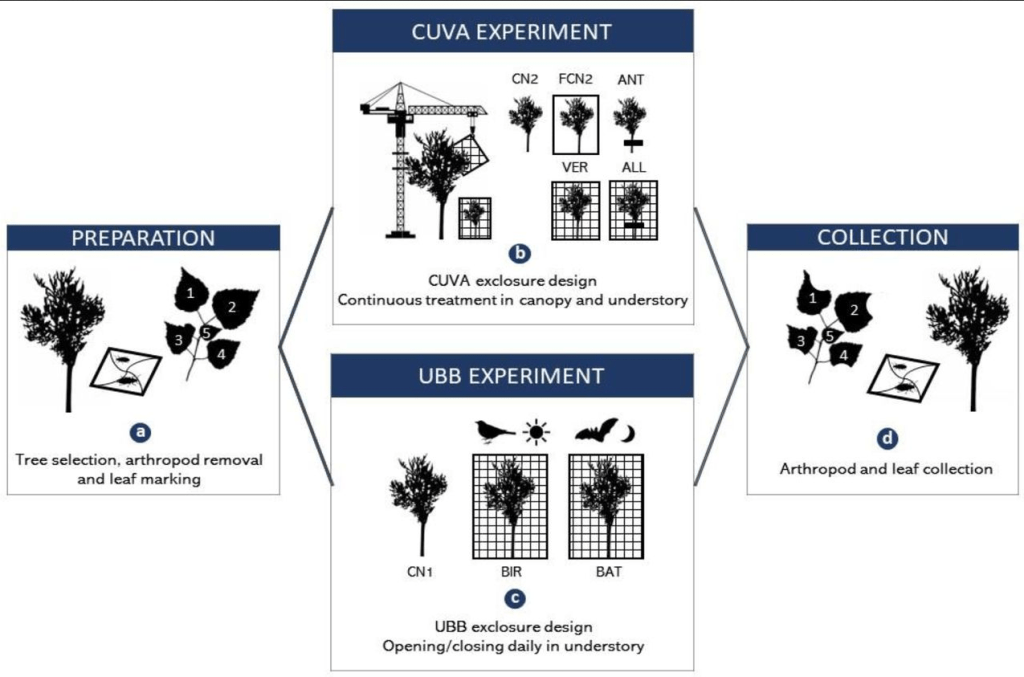
In contrast to our expectations, we for example found more arthropods on foliage in understory than in canopy. Further surprise was that the effect of vertebrate predators was very similar in canopy and understory.

 multitrophicinteractions.blog